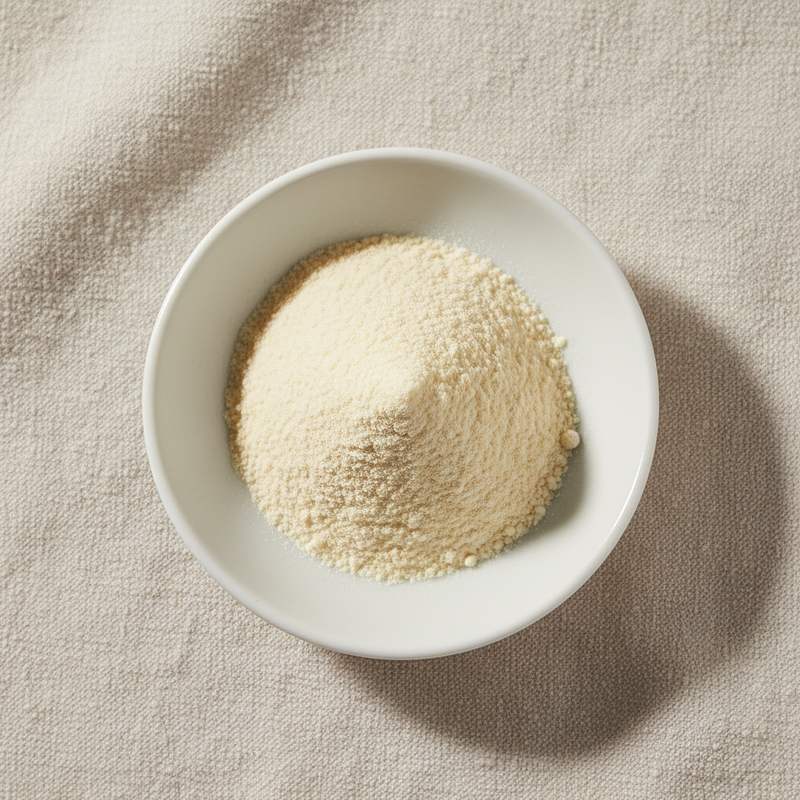
Pectin vs Carrageenan vs Gellan in Plant-Based Dairy: Setting, Mouthfeel, and Cost
Pectin, carrageenan, and gellan are the gelling agents behind plant-based dairy, desserts, and set products. They all form gels, but through different mechanisms, and in plant dairy the way a hydrocolloid interacts with protein and calcium matters as much as the gel itself.
If you produce plant-based dairy, dessert gels, or set products, here is the data, the mechanism, use levels, and the failure modes.
The data table
| Property | Pectin | Carrageenan | Gellan |
|---|---|---|---|
| Source | Fruit (citrus, apple) | Red seaweed | Microbial fermentation |
| Set trigger | HM: sugar plus acid; LM: calcium | Potassium and calcium | Calcium and other ions |
| Gel texture | Clean, short to elastic | Kappa firm/brittle, iota soft/elastic | Low-acyl firm/brittle, high-acyl soft/elastic |
| Protein interaction | Protects protein at low pH | Strong (casein, plant protein) | Weak (suspension, not binding) |
| Typical use level | 0.2 to 1% | 0.01 to 0.5% | 0.01 to 0.25% |
| Heat stability | Set holds; HM needs acid | Sets on cooling | Low-acyl is very heat-stable |
| Clarity | Good | Can be hazy | Excellent (low-acyl) |
Mechanism: why each sets and interacts as it does
Pectin. High-methoxyl pectin gels when sugar and acid remove the water around the chains and protonate the carboxyl groups, letting chains associate (a sugar-acid gel). Low-methoxyl pectin instead uses calcium to bridge carboxyl groups (the egg-box model), so it sets at low sugar and across a wider pH. Critically, in acidified protein drinks LM pectin adsorbs onto the protein surface and gives it a like charge, so the protein particles repel each other instead of aggregating. That is why pectin stabilizes drinkable yogurt and acidified soy or oat drinks.
Carrageenan. Sulfated galactose chains form double helices on cooling, then aggregate into a gel with potassium (kappa, firm) or calcium (iota, elastic). The sulfate groups also bind to positively charged regions on casein and plant proteins, which is why carrageenan suspends cocoa and stabilizes protein in dairy and plant milks at tiny doses. This protein binding is its signature.
Gellan. Forms helices that associate through ion bridging. Low-acyl gellan gives a firm, brittle, very clear, heat-stable gel at extremely low dose. High-acyl gives a soft, elastic gel. Blending the two dials texture. Gellan suspends particles through a weak fluid-gel network rather than binding protein, which is why it is the modern choice for keeping calcium and protein suspended in plant milk without viscosity (see plant-based milk formulation).
Troubleshooting
| Problem | Likely cause | Fix |
|---|---|---|
| Protein sediments in acidified drink | No protein protection | Use LM pectin to coat and stabilize protein |
| Cocoa or calcium settles in plant milk | Insufficient suspension | Add low-acyl gellan or kappa carrageenan |
| Gel too brittle | Kappa carrageenan or low-acyl gellan alone | Blend with locust bean gum, iota, or high-acyl gellan |
| HM pectin will not set | pH too high or too little sugar | Lower pH, raise soluble solids, or switch to LM plus calcium |
| Hazy gel where clarity needed | Carrageenan haze | Use low-acyl gellan for clarity |
| Gel melts in warm storage | Heat-labile set | Use agar or low-acyl gellan (heat-stable) |
Choose by what you produce
- If you produce chocolate plant milk, flan, or protein desserts, carrageenan (kappa or iota) for the protein interaction.
- If you produce a plain plant milk needing suspension without viscosity, low-acyl gellan.
- If you produce acidified drinks or drinkable yogurt, low-methoxyl pectin for protein protection.
- If your finished products must be heat-stable, agar or low-acyl gellan (see gelatin alternatives for the full hydrocolloid map).
We supply Pectin, Carrageenan, Kappa-Carrageenan Refined, Iota-Carrageenan Refined, Gellan Gum, and High-Acyl Gellan Gum in bulk with documentation. Tell us your base, pH, protein system, and target texture, and we will recommend the hydrocolloid or blend and quote cost-in-use.