Description
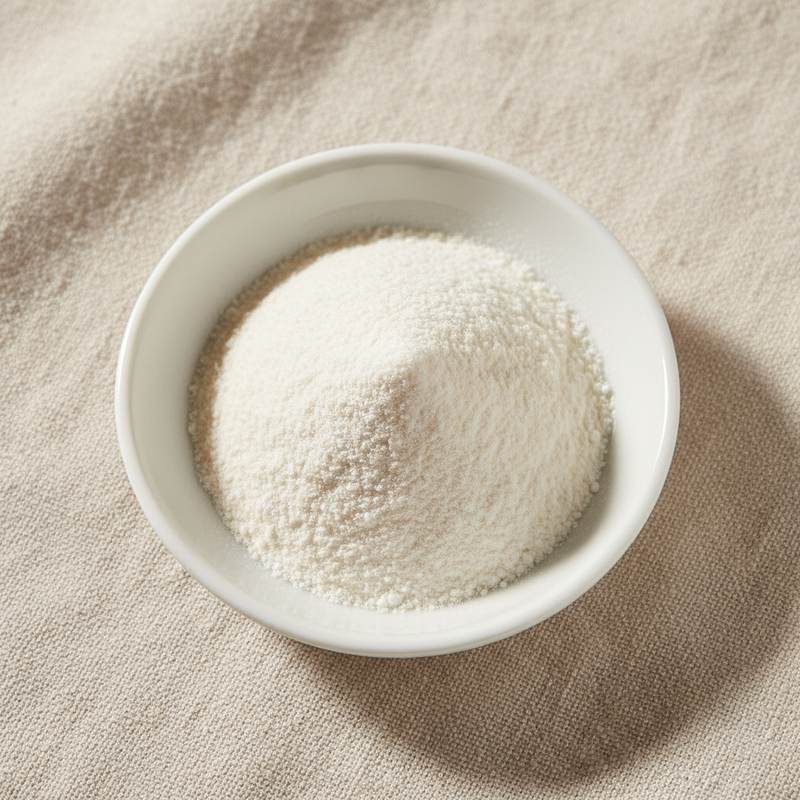
An anionic food-grade emulsifier produced by esterification of stearic acid with lactic acid and neutralized with calcium. The calcium salt form is preferred where dough strengthening is the dominant requirement and water dispersibility is less critical than for the sodium counterpart.
White to slightly yellowish brittle solid or free-flowing powder with a characteristic fatty odor. Soluble in hot oils and dispersible in warm water. Functions as a dough strengthener, crumb softener, and starch-complexing agent in yeast-raised and chemically leavened bakery goods.
We supply food-grade Calcium Stearoyl Lactylate from manufacturers in China holding ISO, Halal, Kosher and other certifications relevant to the product and production.
Common market grades include standard powder for direct addition to flour and pre-mix systems, and brittle solid for melting into fat phases. Typical dosing is 0.25 to 0.5 percent on flour weight in pan bread and 0.5 to 1.0 percent in hearth and bagel formulations.
Bulk and reduced-MOQ shipments. Batch-level COA covering acid value, ester value, calcium content, total lactic acid, heavy metals, and microbiology.
Introduction
Stearoyl lactylates were developed in the United States during the 1950s and approved as bread improvers in the early 1960s, becoming one of the first synthetic emulsifiers permitted in commercial baking. The calcium salt followed the earlier commercial sodium variant and remains the preferred form in dough-strengthening applications where the lower water solubility is technically useful.
Industrial production combines food-grade stearic acid with lactic acid under controlled esterification conditions, followed by neutralization with calcium hydroxide. The finished product is a complex mixture of mono- and di-stearoyl lactylate esters together with free lactic acid, free fatty acid, and minor polymeric lactic species.
Regulated as E482 in the EU under Commission Regulation 1333/2008, classified as Generally Recognized as Safe by the U.S. FDA under 21 CFR 172.844, and approved by JECFA with a group Acceptable Daily Intake of 0 to 20 mg per kg body weight covering CSL and SSL together.
The functional mechanism in dough is dual. The stearate portion complexes with amylose in starch granules to slow staling, while the lactylate portion interacts with gluten proteins to strengthen the protein network, improving gas retention, oven spring, and slicing characteristics. The combined effect is most visible in mechanically processed industrial bread, where dough strength and machinability are routinely limiting variables.
Strategically, CSL competes with SSL, DATEM, and enzyme-based bread improvers. The calcium salt is typically chosen where stronger dough effect and lower hygroscopicity matter, the sodium salt where superior batter aeration and water dispersibility are needed.
Where it is used
- Dough strengthening and oven-spring improvement in yeast-raised pan bread, buns, and rolls
- Crumb softening and anti-staling action across packaged sliced bread and sandwich loaves
- Texture and rollability improvement in flour tortillas, pita, and flatbreads
- Volume and stability enhancement in laminated doughs and frozen dough systems
- Emulsification in non-dairy coffee whiteners and powdered drink mixes
- Firmness improvement in pasta, instant noodles, and rice noodle formulations
- Foam stabilization in dehydrated egg white replacers and whipped toppings
- Starch complexing in extruded breakfast cereals and snack products
Technical data
| Item | Specification |
|---|---|
| Appearance | White to slightly yellowish powder or brittle solid with characteristic odor |
| Acid Value | 60 to 130 mg KOH/g |
| Ester Value | 90 to 190 mg KOH/g |
| Calcium content | 1.0% to 5.2% |
| Total lactic acid | 15.0% to 40.0% |
| Heavy metals (as Pb) | ≤ 10 mg/kg |
| Lead | ≤ 2 mg/kg |
| Arsenic | ≤ 3 mg/kg |
| Mercury | ≤ 1 mg/kg |
| Cadmium | ≤ 1 mg/kg |
| Particle size | Per customer specification |
Related ingredients
Ready to discuss business?
Send us your spec and requirement. We will respond with availability and pricing within 24 hours.