Description
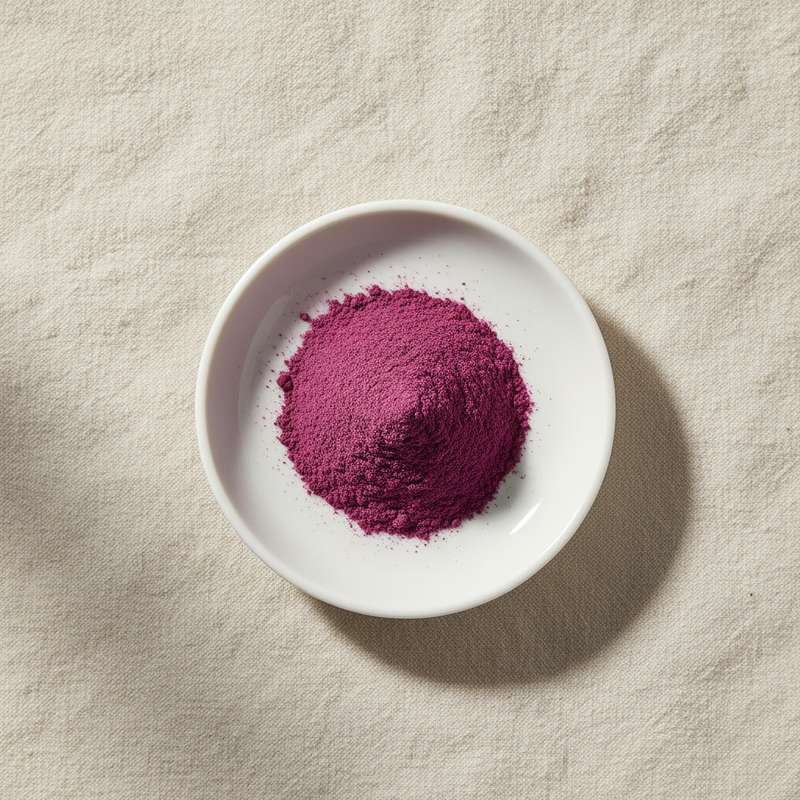
A family of natural red, purple, and blue colorants extracted from anthocyanin-rich plant sources including grape skin, black currant, elderberry, hibiscus, and red cabbage. Produces a hue ranging from red and pink at acidic pH to violet and blue at neutral to alkaline pH.
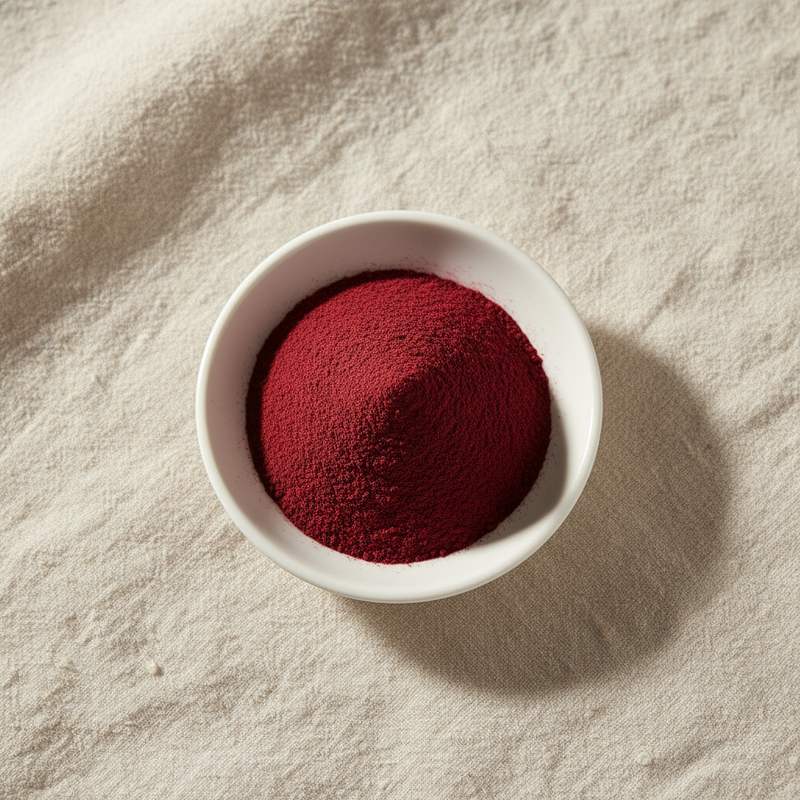
Dark red to violet free-flowing powder, or red to dark purple liquid concentrate. Highly water-soluble. Performs best in acidic applications where the flavylium cation form delivers bright stable color.
We supply food-grade Anthocyanin from manufacturers in China holding ISO, Halal, Kosher and other certifications relevant to the product and production. Organic-certified material and specific botanical sources are available on request.
Common market grades are sold by color value as E1% at 520 to 530 nm: 50, 100, 150, 200, and 300, with liquid concentrates at 0.5 to 3 percent active anthocyanin. Source-specific products (grape skin, black currant, elderberry, hibiscus) carry different hue characteristics within the broader E163 designation.
Bulk and reduced-MOQ shipments. Batch-level COA covering total anthocyanin content, color value, pH, heavy metals, sulfite residue, and microbiology.
Introduction
Anthocyanins are the dominant pigment family responsible for the red, purple, and blue colors of flowers and many fruits, and were among the first natural colorants standardized for commercial food use in the twentieth century.
Production begins with selected high-anthocyanin plant material including grape skin (a by-product of wine production), black currant pomace, elderberry, hibiscus, and red cabbage. The plant material is extracted with acidified water or ethanol, the extract is purified by ion-exchange or membrane filtration, concentrated under vacuum, and either packed as liquid or spray-dried with a carrier to defined color strength.
Regulated as E163 in the EU, listed by the U.S. FDA as a permitted color additive exempt from certification when derived from fruit and vegetable juice (with the additional category designation of fruit juice or vegetable juice color), and approved by JECFA without a numerical Acceptable Daily Intake limit for anthocyanins from grape skin.
The principal technical challenge is pH-dependent color expression. Anthocyanins are red and bright at pH below 4, shift to violet and gray-purple at neutral pH, and turn green or blue at alkaline pH. Heat and light stability are moderate, with sulfur dioxide bleaching the color and metal ions (especially iron and aluminum) shifting hue. Acylated and source-specific products including purple sweet potato and purple corn deliver materially better stability than grape skin and elderberry extracts.
Strategically, Anthocyanin is the natural red and purple workhorse of the acidic beverage, fruit preparation, and confectionery segments, and replaces synthetic Allura Red (E129), Carmoisine (E122), and Ponceau 4R (E124) in clean-label reformulation.
Where it is used
- Acidic beverages including soft drinks, juice drinks, and sports drinks where pH 3 to 4 delivers bright stable red and pink
- Fruit preparations, jams, jellies, and dessert fillings
- Wine production and wine-color enhancement applications
- Yogurt and acidic dairy products where culture-driven pH supports color
- Sugar confectionery, gummies, and hard candies
- Ice cream, sorbet, and frozen dairy desserts
- Bakery fillings and decorations for acidic applications
- Functional foods and supplements positioned for antioxidant and polyphenol marketing
Technical data
| Item | Specification |
|---|---|
| Appearance | Dark red to violet powder or red to purple liquid |
| Source | Grape skin, black currant, elderberry, hibiscus, or red cabbage |
| Color value (E1%, 1cm, 520 to 530 nm) | 50, 100, 150, 200, or 300 (per grade) |
| Total anthocyanins | Per declared color value |
| pH (10% solution) | 2.5 to 4.0 |
| Solubility | Freely soluble in water; insoluble in oil |
| Light stability | Moderate; source-dependent |
| Heat stability | Moderate; source-dependent |
| pH stability range | Best at pH 3 to 5; shifts above pH 6 |
| Sulfur dioxide | ≤ 100 mg/kg |
| Lead | ≤ 2 mg/kg |
| Arsenic | ≤ 1 mg/kg |
| Total plate count | ≤ 1000 CFU/g |
Related ingredients
Ready to discuss business?
Send us your spec and requirement. We will respond with availability and pricing within 24 hours.