Description
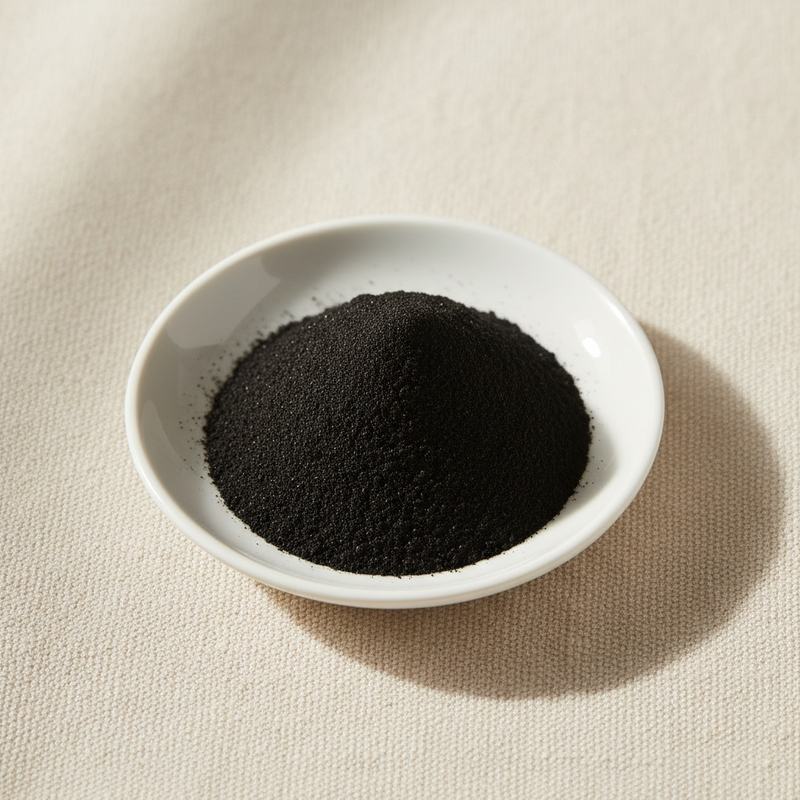
A natural deep black pigment produced by controlled carbonization of plant material including coconut shell, bamboo, and other vegetable feedstocks. Listed in the EU as E153 and widely accepted as a natural-origin black colorant in clean-label applications.
Dull black to deep black free-flowing fine powder. Water-insoluble and oil-insoluble; dispersed by physical means in the application matrix or supplied as a water-dispersible preparation on a hydrocolloid carrier.
We supply food-grade Vegetable Carbon from manufacturers in China holding ISO, Halal, Kosher and other certifications relevant to the product and production. Activated and non-activated grades are produced with different particle-size and adsorption profiles.
Common market grades are sold by source (coconut shell, bamboo, or mixed vegetable origin) and by particle size distribution. Color value and bulk density vary by grade, with finer particles delivering deeper jet-black shades. Water-dispersible compounded preparations are produced at 5 to 20 percent active carbon content.
Bulk and reduced-MOQ shipments. Batch-level COA covering carbon content, polycyclic aromatic hydrocarbons (PAH), heavy metals, residual solvent, and microbiology.
Introduction
Carbon black from carbonized plant material has been used as a pigment and dietary adsorbent since antiquity. Industrial production of food-grade vegetable carbon developed in the twentieth century alongside expansion of the cheese and bakery industries.
Production proceeds by controlled carbonization of plant material (typically coconut shell or bamboo) under limited oxygen at high temperature, followed by milling to defined particle size and purification by acid washing and water rinsing to remove inorganic ash. The product is standardized to defined carbon content and PAH limits.
Regulated as E153 in the EU and approved by JECFA without a numerical Acceptable Daily Intake limit when meeting purity specifications. The U.S. FDA permits vegetable carbon for use in dietary supplements and dental products but has not approved it as a color additive for general food use; charcoal added to food is regulated under separate framework. Approved in major Asian markets.
Technical performance is excellent: fully stable through baking, retort, UHT, frying, and pasteurization, broad pH compatibility across the full food range, and excellent light stability. The principal specification concern is polycyclic aromatic hydrocarbon content, which is controlled to below 50 micrograms per kg total PAH and below 1 microgram per kg benzo(a)pyrene in food-grade material.
Strategically, Vegetable Carbon Black is the dominant clean-label black colorant and is positioned both for visual effect in black bakery and confectionery applications and for the broader detox and wellness marketing trend.
Where it is used
- Black ice cream, sorbet, and frozen dessert applications
- Black bread, charcoal buns, and specialty bakery products
- Black noodles, pasta, and Asian wheat-based products
- Sugar confectionery, gummies, and panned candies in jet-black shades
- Dietary supplements and detox-positioned functional products
- Cheese rind treatments and specialty cheese coatings
- Wellness beverages including activated charcoal lemonade in EU markets
- Pharmaceutical tablet coatings and capsules
- Cosmetics including charcoal masks and toothpaste
Technical data
| Item | Specification |
|---|---|
| Appearance | Dull black to deep black powder |
| Source | Coconut shell, bamboo, or mixed vegetable origin |
| Carbon content | ≥ 95.0% |
| Solubility | Insoluble in water and oil; dispersible |
| Light stability | Excellent |
| Heat stability | Excellent; fully stable through baking and retort |
| pH stability range | Full food pH range |
| Total PAH (16 EU priority) | ≤ 50 µg/kg |
| Benzo(a)pyrene | ≤ 1 µg/kg |
| Loss on ignition | Per declared grade |
| Lead | ≤ 2 mg/kg |
| Arsenic | ≤ 1 mg/kg |
| Total plate count | ≤ 1000 CFU/g |
Related ingredients

Ready to discuss business?
Send us your spec and requirement. We will respond with availability and pricing within 24 hours.