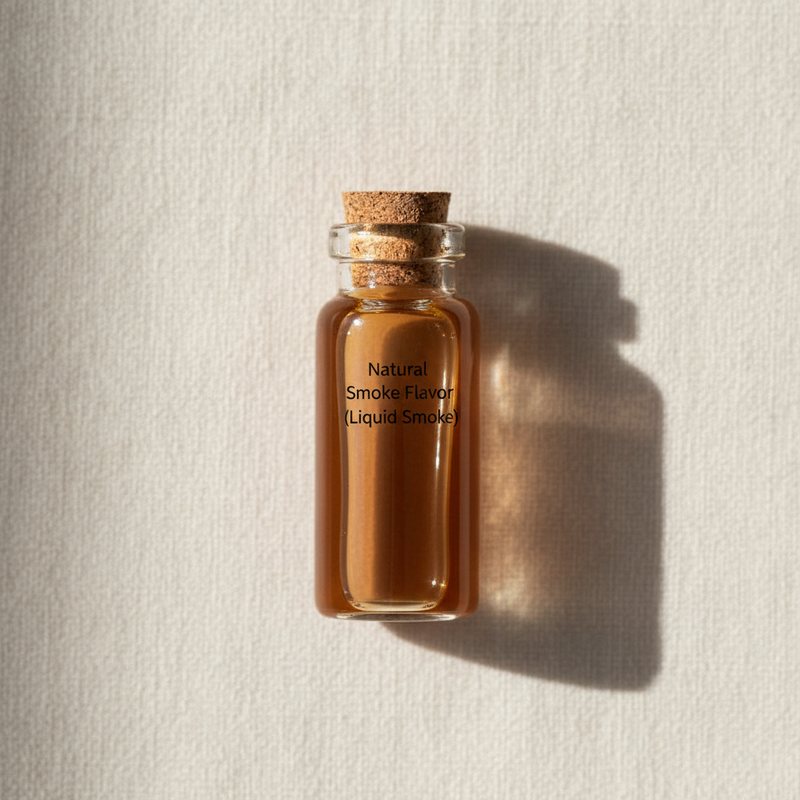
Description
A condensed and purified wood-smoke flavoring used as a labor-saving, food-safety-friendly alternative to traditional smokehouse processing of cured meats. Liquid Smoke delivers smoked flavor, smoke-derived antimicrobial activity, and characteristic smoked color in sausage, ham, bacon, and jerky applications.
Pale yellow to dark amber liquid, or spray-dried powder on a maltodextrin or salt carrier. Produced by controlled smoldering of hardwood (typically hickory, oak, mesquite, applewood, or cherry), condensation of the smoke vapor, and filtration to remove polycyclic aromatic hydrocarbons (PAHs) to below food-safety limits.
We supply food-grade Natural Smoke Flavor in liquid and powder forms from manufacturers and partner facilities holding ISO, Halal, Kosher and other certifications relevant to the product and production. EU-compliant grades meeting Commission Regulation (EU) 2065/2003 maximum levels for benzo[a]pyrene and PAH4 are supplied for EU-targeted product.
Common market grades include Hickory, Mesquite, Oak, and Applewood liquid smokes at standard and high-strength concentrations; spray-dried smoke powders at 5 to 25 percent active on a maltodextrin carrier; and atomization-grade smoke condensates for in-line application to sausage casings and surfaces.
Bulk and reduced-MOQ shipments. Batch-level COA covering acid content, phenol content, color (staining index), PAH compliance, and microbiology.
Introduction
Liquid smoke was patented by E. H. Wright in 1895 and has been produced commercially in the United States since the early twentieth century. The category accelerated industrially in the 1970s as the meat industry sought to reduce smokehouse processing time, control polycyclic aromatic hydrocarbon levels in smoked meats, and standardize smoke flavor across production lines.
Production starts with controlled pyrolysis of hardwood at temperatures of 380 to 400 °C in a low-oxygen environment, producing a smoke vapor rich in carbonyls, phenols, organic acids, and water. The vapor is condensed, then aged and filtered to separate the polycyclic aromatic hydrocarbon fraction (which partitions into tar) from the flavor-active water-soluble fraction.
Regulated as a flavoring substance in most jurisdictions, classified as Generally Recognized as Safe by the U.S. FDA for traditional uses, and subject in the EU to a positive-list authorization regime under Regulation (EC) 2065/2003 with named smoke flavorings undergoing EFSA safety assessment.
The food-safety case for liquid smoke over traditional smokehouse smoke is straightforward: removal of the PAH-rich tar fraction during liquid-smoke manufacture leaves the finished flavor compliant with EU benzo[a]pyrene limits of ≤ 2 µg/kg and PAH4 limits of ≤ 12 µg/kg in finished meat products, which traditional natural smoke generation cannot reliably achieve.
Application methods range from in-formulation dosing into emulsion sausages (typical levels 0.05 to 0.3 percent), through casing dipping and atomization onto product surfaces in continuous smokehouses, to spray-dried smoke powders incorporated into dry-mix seasoning systems for jerky and meat snacks. The choice of hardwood drives the flavor profile: hickory delivers the strong assertive smoke of U.S. BBQ tradition, mesquite a sharper smoke note, applewood a milder fruity smoke, oak a balanced European character.
Where it is used
- Cooked frankfurters, wieners, and hot dogs as a casing-applied or in-formulation smoke flavoring
- Smoked hams, picnic hams, and shoulder products in cookout brines and surface-application sprays
- Bacon and pre-cooked bacon for natural smoke flavor without smokehouse processing time
- Smoked sausages including kielbasa, kabanos, and andouille; in-formulation dosing and surface application
- Meat jerky and meat snacks; standard ingredient for smoked-flavor profiles in oven-cooked product
- Smoked deli meats including pastrami, smoked turkey breast, and smoked roast beef
- BBQ sauces, marinades, and rubs intended for smoked-meat applications
- Plant-based meat analogues for smoked-flavor positioning in vegan sausages and jerky
Technical data
| Item | Specification |
|---|---|
| Appearance | Pale yellow to dark amber liquid (or off-white powder on carrier) |
| Wood source | Hickory, oak, mesquite, applewood, cherry, or blended (per customer specification) |
| Acid content (as acetic acid) | 3% to 12% (liquid) |
| Phenol content | 2 to 25 mg/g (per grade) |
| Carbonyl content | 5% to 20% (liquid) |
| Browning index (staining capacity) | Per grade specification |
| Benzo[a]pyrene | ≤ 10 µg/kg in flavoring (EU-compliant grade) |
| PAH4 (4 polycyclic aromatic hydrocarbons) | ≤ 20 µg/kg in flavoring (EU-compliant grade) |
| pH | 2.0 to 3.0 (liquid) |
| Total plate count | ≤ 1,000 CFU/g |
Related ingredients
Ready to discuss business?
Send us your spec and requirement. We will respond with availability and pricing within 24 hours.