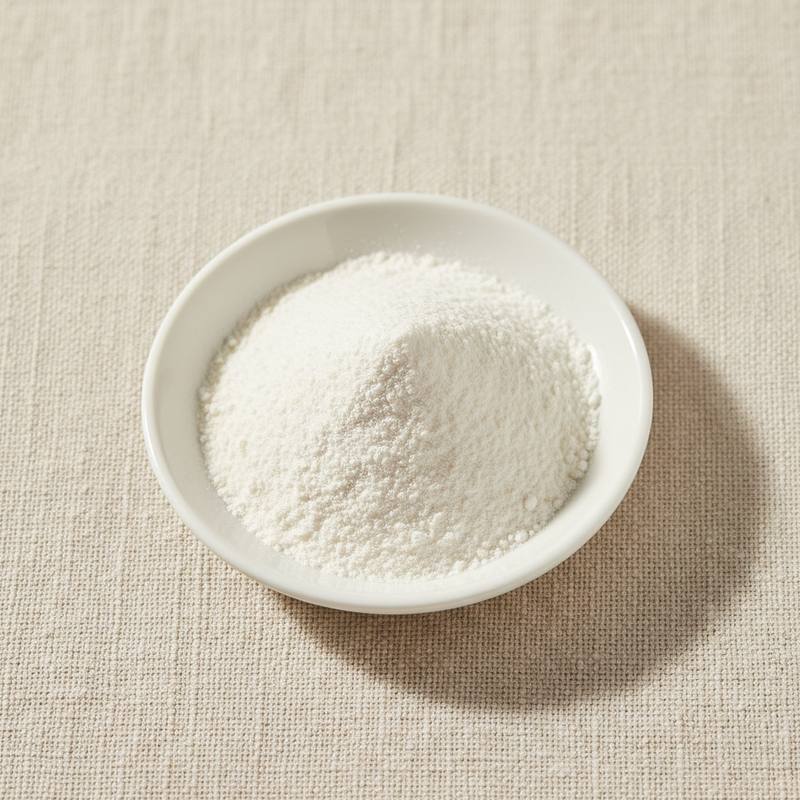
Description
Calcium salt of the stearoyl-lactylate condensation product of stearic acid and lactic acid. The calcium counterpart of SSL, with a stronger dough-strengthening profile and slightly different emulsifier characteristics.
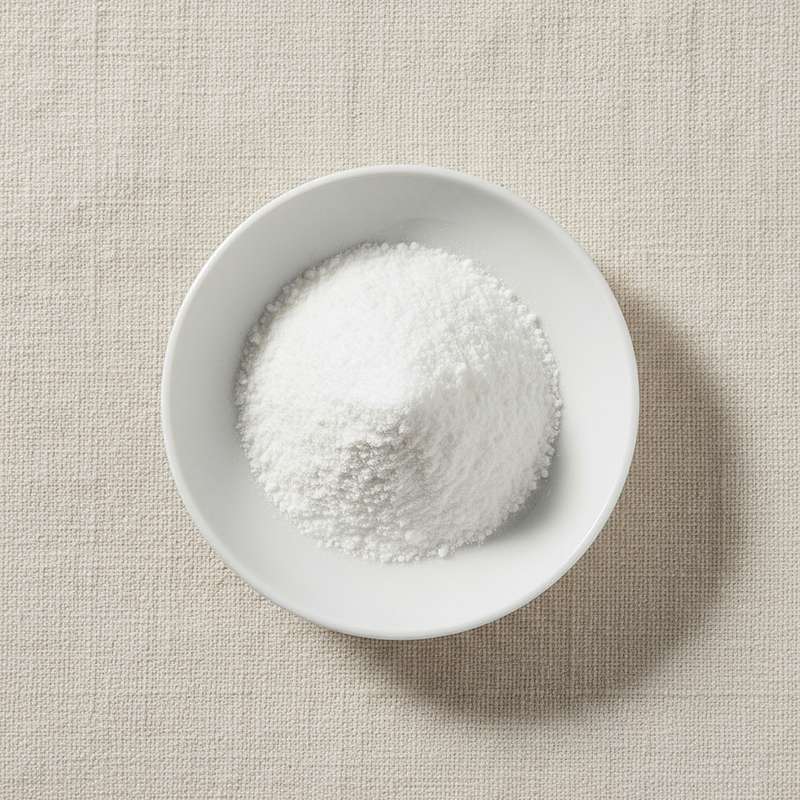
Cream to light-tan powder or flake. Practically insoluble in cold water; disperses on heating into mixed liquor and dough systems.
We supply food-grade Calcium Stearoyl Lactylate from manufacturers in China holding ISO, Halal, Kosher and other certifications relevant to the product and production.
Common market grades include food-grade powder and flake for industrial bakery use, food-grade granular for direct addition in continuous-mix bread, and personal-care grade for cosmetic emulsions. Vegetable-source stearic acid is the default for Halal and Kosher applications.
Bulk and reduced-MOQ shipments. Batch-level COA covering acid value, ester value, calcium content, heavy metals, and microbiology.
Introduction
Calcium Stearoyl Lactylate was developed alongside SSL as the calcium-cation member of the stearoyl-lactylate emulsifier family. The two compounds share the same fundamental chemistry but differ in solubility and dough interaction. CSL is more strongly dough-strengthening and less soluble; SSL is more crumb-softening and more readily dispersible.
Industrial production proceeds by the same condensation and esterification route as SSL, with calcium hydroxide rather than sodium hydroxide as the neutralizing base. The resulting product is a mixture of mono-, di-, and tri-lactylate stearate calcium salts, with composition controlled by reaction conditions.
Regulated in the EU as E482, classified by the U.S. FDA under 21 CFR 172.844 with specific permitted uses and maximum levels, and approved by JECFA within the same 20 mg/kg body weight Acceptable Daily Intake group as SSL.
Mechanism in dough parallels SSL but with differentiated emphasis. The calcium counterion forms tighter complexes with gluten proteins, producing a stronger dough that holds up better in long-fermentation and high-water-absorption formulations. The lactylate head group complexes amylose to retard staling, the same mechanism as SSL. CSL is typically dosed at marginally higher rates than SSL when used alone, or at equivalent rates when combined with SSL in dual-emulsifier systems.
Strategic positioning: CSL is the dough-strengthening partner of SSL in industrial baking. Formulators choose between the two, or use both together, based on the specific bread type, fermentation system, and required balance of crumb softness versus dough strength. Whole-wheat, multigrain, and high-fiber formulations particularly benefit from CSL's stronger gluten-strengthening profile.
Where it is used
- Dough strengthener in pan bread, hearth bread, and whole-wheat bread formulations
- Volume enhancer in industrial bun and roll production at 0.3 to 0.5 percent on flour weight
- Tortilla and flatbread conditioner improving rollability and reducing dough stickiness
- Hi-ratio cake mix emulsifier in combination with SSL or distilled monoglycerides
- Crumb softener and anti-staling agent in packaged bread, especially whole-grain products
- Egg-substitute functionality in industrial bakery applications
- Stabilizer in non-dairy creamers and powdered beverage whiteners
- Emulsifier in pharmaceutical tablets and oral suspensions
- Personal-care emulsifier in skin and hair care formulations
Technical data
| Item | Specification |
|---|---|
| Appearance | Cream to light-tan powder or flake |
| Acid value | 50 to 86 mg KOH/g |
| Ester value | 125 to 190 mg KOH/g |
| Total lactic acid | 32.0% to 38.0% |
| Calcium content | 4.2% to 5.2% |
| Loss on drying | ≤ 4.0% |
| Heavy metals (as Pb) | ≤ 10 mg/kg |
| Arsenic | ≤ 3 mg/kg |
| Total plate count | ≤ 10,000 cfu/g |
| Source of stearic acid | Vegetable (palm) or tallow per customer specification |
Related ingredients
Ready to discuss business?
Send us your spec and requirement. We will respond with availability and pricing within 24 hours.