Description
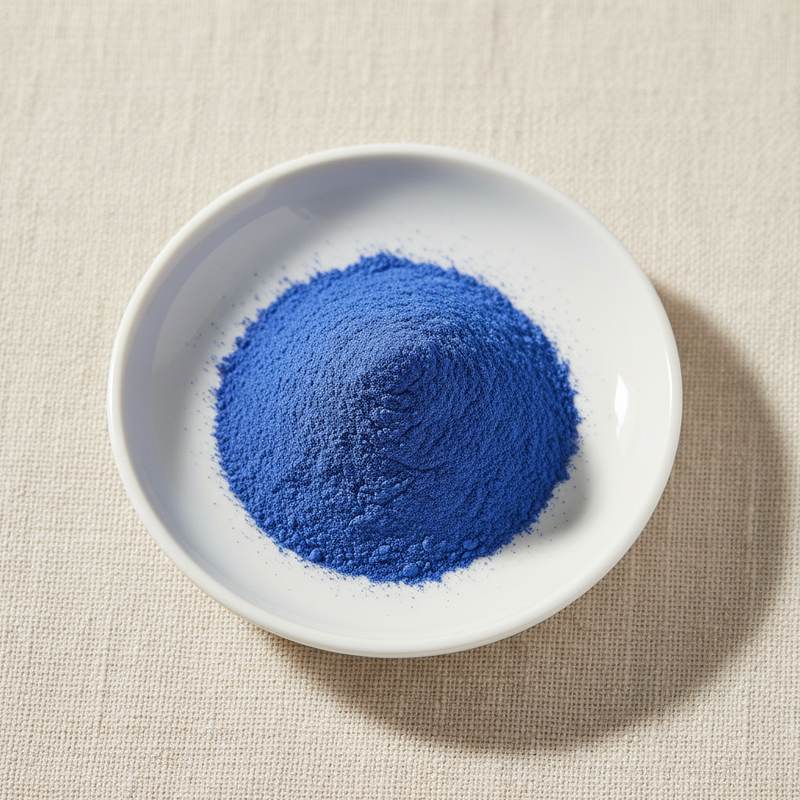
A synthetic deep blue to violet-blue water-soluble indigoid dye. Chemically the disodium salt of indigo-5,5-disulfonic acid, listed in the United States as FD&C Blue 2 and in the EU as E132. Delivers a deeper, more violet-toned blue than Brilliant Blue FCF.
Dark blue to bluish-black free-flowing fine powder. Water-soluble in the dye form, with the corresponding aluminum lake available for fat-based, tablet-coating, and confectionery applications.
We supply food-grade Indigotine from manufacturers in China holding ISO, Halal, Kosher and other certifications relevant to the product and production. Both the soluble dye and the aluminum lake are produced.
Common market grades are sold by dye content: pure dye at minimum 85 percent total coloring matter and aluminum lake at 10 percent to 40 percent dye content.
Bulk and reduced-MOQ shipments. Batch-level COA covering total dye content, subsidiary colors, isatin sulfonic acid, heavy metals, and microbiology.
Introduction
Indigotine is the water-soluble sulfonated form of natural indigo, the historic textile dye obtained from Indigofera species and from woad. Industrial production by chemical synthesis dates to the late nineteenth century and the dye has been used in food and pharmaceutical applications since the early twentieth century.
Production starts from synthetic indigo, which is sulfonated with fuming sulfuric acid and isolated as the disodium salt. The crude dye is purified by recrystallization and standardized to declared total coloring matter content. Aluminum lakes are produced by precipitation onto alumina substrate.
Regulated as E132 in the EU and listed as FD&C Blue 2 in the United States with mandatory ingredient declaration. Approved by JECFA with an Acceptable Daily Intake of 5 mg per kg body weight. In the EU, products containing Indigotine must carry the Southampton-related child-activity warning.
The technical profile is good but materially weaker than Brilliant Blue FCF: light stability is only moderate, oxidative stability is limited (the dye is gradually reduced or oxidized in some food matrices), and the dye is less effective as a colorant per unit mass. Heat stability is good through baking and pasteurization, and pH stability is broad from 2 to 9.
Strategically, Indigotine is the secondary synthetic blue, used where the specific violet-blue shade is required (such as in pharmaceutical tablet coatings and certain pet-food applications) and as a complement to Brilliant Blue in custom-shade blends.
Where it is used
- Sugar confectionery, gummies, and hard candies requiring deep violet-blue shade
- Bakery decorations, frosting, and fondant work
- Ice cream, sorbet, and frozen dairy desserts
- Pet food and treats for visual appeal
- Pharmaceutical tablets, capsules, and coated dosage forms
- Cherry, blueberry, and grape-flavored beverages in combination products
- Cosmetics and personal-care preparations
- Veterinary and diagnostic applications including kidney function tests
Technical data
| Item | Specification |
|---|---|
| Appearance | Dark blue to bluish-black powder |
| Chemical class | Synthetic indigoid dye |
| Total coloring matter (dye) | ≥ 85.0% |
| Aluminum lake dye content | 10%, 20%, 30%, or 40% (per grade) |
| Color value (E1%, 1cm, 610 nm) | ≥ 480 |
| Solubility | Freely soluble in water (dye); insoluble (lake) |
| Light stability | Moderate |
| Heat stability | Good through baking and pasteurization |
| pH stability range | 2.0 to 9.0 |
| Isatin sulfonic acid | ≤ 0.4% |
| Lead | ≤ 2 mg/kg |
| Arsenic | ≤ 1 mg/kg |
Related ingredients
Ready to discuss business?
Send us your spec and requirement. We will respond with availability and pricing within 24 hours.